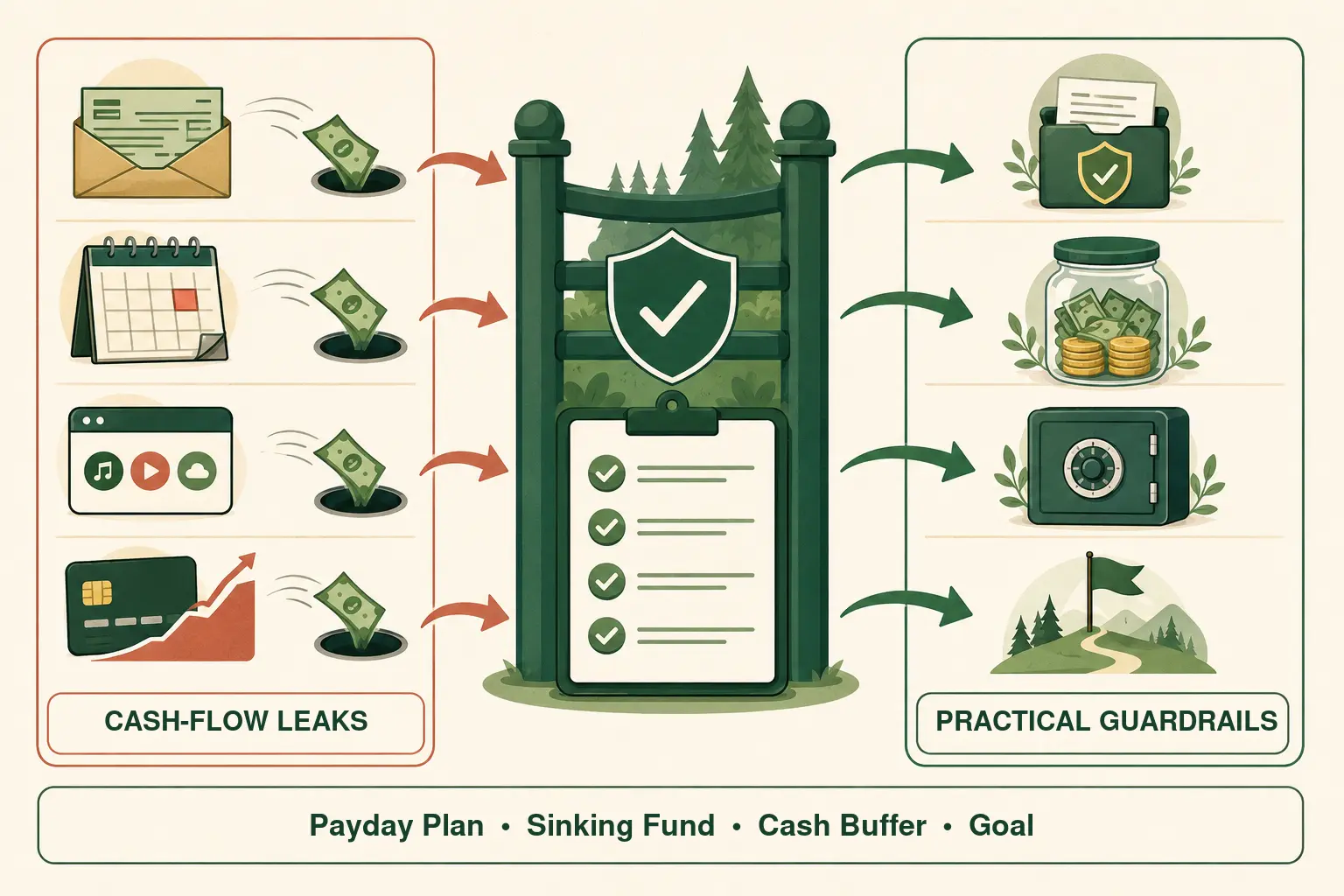
The Earning Money guide can help you increase income, but earning more solves only part of a cash-flow problem. A money habit becomes expensive when it repeatedly creates a shortfall, pushes a predictable bill onto credit, or lets extra income disappear before it reaches a goal.
Which eight money patterns can keep cash flow tight?
| Pattern | Practical guardrail |
|---|---|
| Spending from the payday balance | Fund bills due before the next payday first |
| Treating irregular bills as surprises | Create monthly sinking funds |
| Treating a credit limit as income | Name the repayment source before charging |
| Paying debt without a cash buffer | Protect essentials, minimums, and starter savings |
| Expanding every cost after a raise | Assign the increase before it arrives |
| Ignoring recurring charges | Run a quarterly statement scan |
| Using catchy affordability rules | Test the purchase against actual cash flow |
| Relying on gambling or speculation | Separate entertainment money from financial goals |
1. Are you spending the paycheck before the month happens?
Payday can create a false sense of room because the account balance is briefly high. That money may already belong to rent, utilities, insurance, debt minimums, groceries, childcare, and bills due later in the pay cycle.
Better guardrail: List every bill due before the next payday, move planned savings when the budget allows, set a weekly amount for flexible categories, and leave enough in checking for upcoming fixed costs. Use the Budgeting hub to match bills with paydays.
2. Do irregular bills keep feeling like emergencies?
A yearly insurance premium, registration fee, school expense, holiday trip, or routine repair can feel sudden even when it is predictable.
Expected bill ÷ months until due = monthly set-aside
A $900 bill due in nine months needs about $100 per month.
Saving the monthly share can keep the final bill off a credit card. Start with the next known irregular bill rather than trying to fund every category at once.
3. Are you treating a credit limit like income?
Available credit is borrowing capacity, not extra earnings. Before charging a purchase, name the repayment source. If the answer is that a later paycheck will somehow cover it, the purchase creates a future claim on cash without a plan.
Credit can work as a payment tool when repayment money already exists or the borrowing choice is deliberate. Use the Avoiding New Debt guide when a recurring shortfall is becoming a balance.
4. Are extra debt payments leaving you exposed?
Sending every spare dollar to debt can look efficient while leaving no cash for the next repair, copay, or income gap. That can cause a new balance soon after an old one falls.
Protect essential bills, required minimum payments, and a starter cash buffer before the planned extra debt payment. The right buffer varies by household. MoneyBucket’s Emergency Fund guide can help you choose a first target.
5. Does every raise become a higher monthly baseline?
A raise can disappear when every category expands with it. Before the first higher paycheck, decide how much of the increase will go to current spending, emergency savings, debt, retirement or another long-term goal, and one upgrade you value.
You do not need to save every dollar of a raise. You need to assign the increase before the new income becomes the new minimum lifestyle.
6. Are recurring charges hiding in your statements?
One subscription rarely wrecks a budget. A cluster of forgotten or lightly used charges can quietly remove the margin needed for goals and irregular bills.
Once per quarter, scan the last three months of statements, list recurring charges, mark each as keep, reduce, cancel, or investigate, then redirect any savings at once. The Subscription Cemetery calculator shows what a recurring charge costs over one, five, or ten years.
7. Are catchy rules replacing your real affordability test?
Rules such as “if you cannot buy five, you cannot afford one” ignore income, assets, debt, timing, insurance, and the purpose of a purchase.
- Is the purchase needed now?
- What cash remains after essentials and required payments?
- Is an irregular bill due soon?
- What would financing cost?
- Which goal would the purchase delay?
- Would you buy it without a sale countdown?
Your actual budget beats a memorable slogan.
8. Are gambling or speculative bets carrying the financial plan?
Entertainment spending is different from saving or long-term investing. If you choose to gamble, set a fixed entertainment amount you can lose without harming bills, debt payments, or savings.
Do not make a jackpot, sports bet, meme trade, or speculative asset the required path to a goal. Money needed for next month’s bills should not depend on a risky outcome. Set measurable targets with the financial goals guide.
How can you reset one money habit in 15 minutes?
- Minutes 1 to 3: Check the next payday and every bill due before it.
- Minutes 4 to 6: Find one irregular expense that needs a sinking fund.
- Minutes 7 to 9: Review recurring charges from recent statements.
- Minutes 10 to 11: Check whether extra debt payments leave a cash buffer.
- Minutes 12 to 13: Choose one trigger to change.
- Minutes 14 to 15: Schedule or automate the better action.
Examples include transferring $25 to savings on payday, dividing an annual bill into monthly deposits, removing stored card details from a shopping site, canceling one unused subscription, or setting a 24-hour wait for non-urgent purchases above your chosen amount.
Bad money habits FAQs
What is the worst money habit?
The most damaging pattern depends on the household. A behavior that repeatedly causes missed bills, high-interest borrowing, or no emergency cushion deserves attention before a smaller discretionary cost.
How do I stop spending too much on payday?
Assign the money that must last until the next payday before deciding what is available for flexible spending. A separate bills account or weekly spending transfer can create a clear boundary.
Should I stop all fun spending while paying debt?
Not necessarily. A plan that is too restrictive can be hard to sustain. Protect essentials and required payments, choose a realistic discretionary amount, and keep the extra debt payment consistent.
Is using a credit card a bad money habit?
Not by itself. The problem is carrying balances without a repayment plan, paying avoidable interest, or using credit because the monthly budget is repeatedly short.
How often should I review subscriptions?
A quarterly statement scan is a practical rhythm. Review sooner after a free trial, price increase, move, job change, or financial squeeze.
How can I make a better habit stick?
Reduce the number of steps between the trigger and the better action. Schedule a transfer, rename a savings account, use a bill calendar, or remove stored payment details so the safer choice takes less effort.
- Consumer Financial Protection Bureau: financial well-being
- Federal Reserve: Economic Well-Being of U.S. Households in 2025
The CFPB describes financial well-being through day-to-day control, the ability to absorb a shock, progress toward goals, and freedom of choice. Use these measures to judge whether a new habit is helping.